
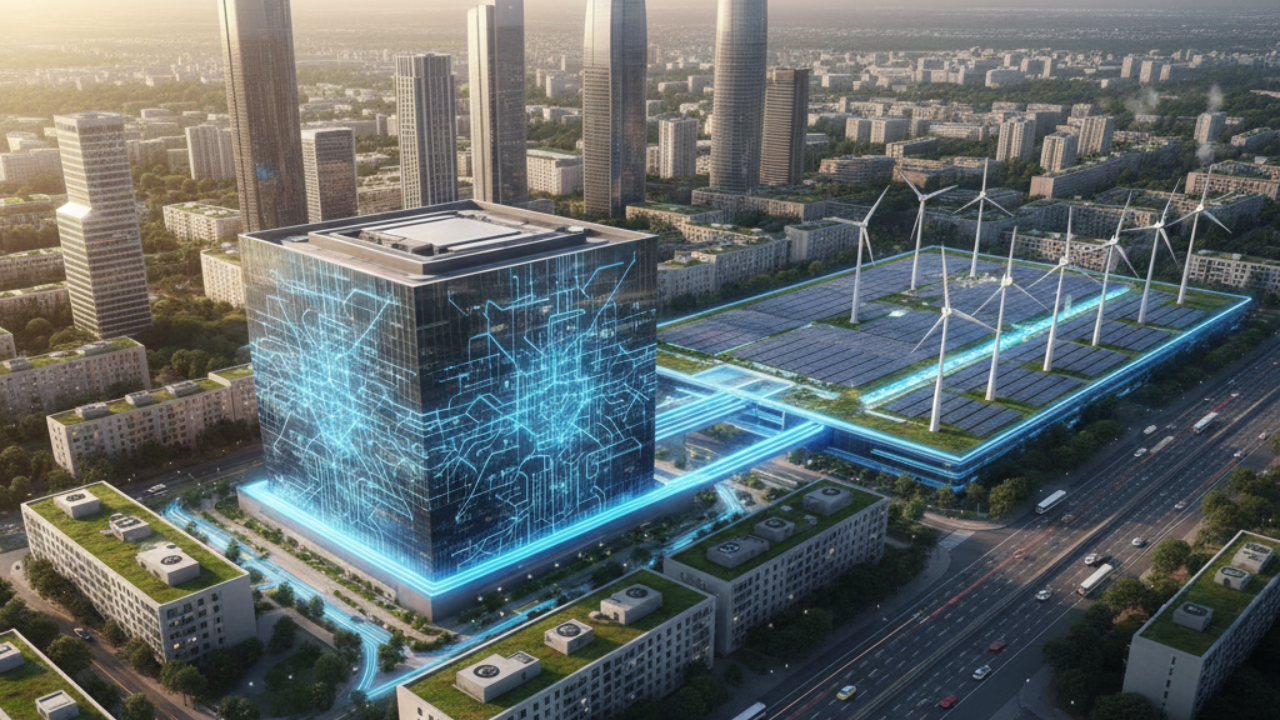
The European real estate landscape is undergoing a structural metamorphosis. If 2024 was the year of “wait and see” and 2025 the year of stabilization, 2026 marks the definitive era of the “Industrial-Tech Pivot.” Traditional pillars like commercial offices and retail, once the undisputed sovereigns of institutional portfolios, have ceded their “core” status to the backbone of the digital economy: Data Centers and Energy Infrastructure.
This evolution represents a significant leap from the strategies discussed in our previous analysis on Real Estate Funds in Europe, where we explored the flexibility and tax efficiency of collective investment vehicles. Today, that same flexibility is being leveraged to capture the explosive demand for high-tech industrial assets.
The Digital Backbone: Why Data Centers are the New Prime Office
In 2026, the valuation of a real estate asset is increasingly measured in megawatts rather than square meters. The rapid integration of Artificial Intelligence (AI) into every corporate layer has created an insatiable hunger for processing power, and consequently, for the physical spaces that house it.
Data centers have transitioned from niche “alternative” investments to a primary target for pension funds and sovereign wealth funds. The reason is simple: vacancy rates in Tier 1 markets (Frankfurt, London, Amsterdam, Paris, and Dublin) are at historic lows, while pre-leasing activity for upcoming developments is reaching 80-90%.
The Drivers of the 2026 Data Surge
The dominance of this asset class is fueled by three inescapable forces:
- The AI Revolution: Generative AI requires three to five times more power density than traditional cloud computing, forcing a redesign of cooling systems and floor loads.
- Sovereign Data Clouds: New EU regulations regarding data residency are compelling companies to store data within national borders, sparking a construction boom in Tier 2 cities like Milan, Warsaw, and Madrid.
- Latency Requirements: The rise of Edge computing is driving investment into smaller, localized data hubs closer to end-users.
Energy Infrastructure: The “Essential” Layer
One cannot discuss the future of European Real Estate without addressing the “Power Gap.” In 2026, a plot of land with a secured grid connection is worth significantly more than one with a building permit. As a result, real estate investors are becoming, by necessity, energy investors.
1. On-site Power Generation
Modern logistics hubs and data centers are no longer just passive shells. They are becoming micro-grids, featuring extensive solar arrays, battery energy storage systems (BESS), and even small-scale hydrogen fuel cells. This shift allows landlords to sell energy back to tenants, creating a secondary, high-margin revenue stream.
2. The Vertical Integration of Utilities
The most sophisticated funds are now acquiring energy firms or forming joint ventures with utility providers to bypass the bottleneck of aging public grids. By owning the substation or the renewable source, the “Real Estate” asset becomes a self-sustaining ecosystem, largely immune to the volatility of global energy markets.
The Regulatory Tailwind: ELTIF 2.0 and Tax Efficiency
The transition toward these complex assets requires sophisticated financial structuring. As we highlighted in our study of European real estate funds, the choice of vehicle is paramount.
In 2026, the ELTIF 2.0 (European Long-Term Investment Fund) has become the preferred wrapper for retail and institutional investors to access these “hard” assets. The ability to pool capital across borders while maintaining tax transparency allows for the massive CAPEX required for energy-integrated real estate. Furthermore, these assets align perfectly with SFDR Article 8 and 9 requirements, making them “green-compliant” by design—a crucial factor for modern capital raising.
From Vision to Vehicle: How Framont Powers Your Infrastructure and Data Center Funds
As we move toward the second half of the decade, the boundaries between real estate sectors are blurring, giving rise to circular economy models like “Heat-as-a-Service”—where data center thermal waste powers local district heating. This convergence of technology and energy is the new benchmark for profitability, and at Framont & Partners Management, we provide the institutional bridge to turn this vision into a reality. We specialize in structuring and managing forward-thinking funds under EU regulations, offering the regulatory and operational expertise required to navigate these complex “new core” asset classes. Through our regulated AIFM platform, we support your strategy with:
- Strategic Fund Setup: Optimized end-to-end structuring for the high-CAPEX demands of data centers and energy infrastructure.
- Specialized Governance: Deep expertise in risk management and compliance tailored to assets where technology and real estate intersect.
- Regulatory Precision: Seamless cross-border operations in Malta, Italy, and across the EU, utilizing efficient vehicles like the ELTIF 2.0.
- Ecosystem Access: Connection to specialized service providers essential for maintaining “green-compliant” and technically advanced portfolios.
In an era where the value of bricks and mortar is determined by the electrons flowing through them, Framont provides the legal framework and regulatory infrastructure to transform technical innovations into compliant, high-performing, and investor-ready fund structures.